Rethinking Commercial RAS Design
Marred by high operational and capital costs, biological risks and significant financial challenges, the lessons emerging from the shortcomings and failures of ambitious, large-scale recirculating aquaculture system (RAS) projects are causing the industry to rethink the way commercial RAS farms are built.
Over the last decade, innovations in RAS have been hyped by a push toward massive, custom-built, land-based “mega farms” with annual production capacities upwards of 5,000 tonnes.
The reality is the vast majority of these large-scale RAS farms, particularly in North America, have yet to materialize or to realize meaningful, stable profitability.
One solution that’s emerging in the industry is standardized modular RAS designs. This design strategy has significant potential to address many of the challenges facing commercial land-based aquaculture, including cost uncertainty, performance unpredictability, operational and project complexity, RAS investability, permitting challenges, and more.
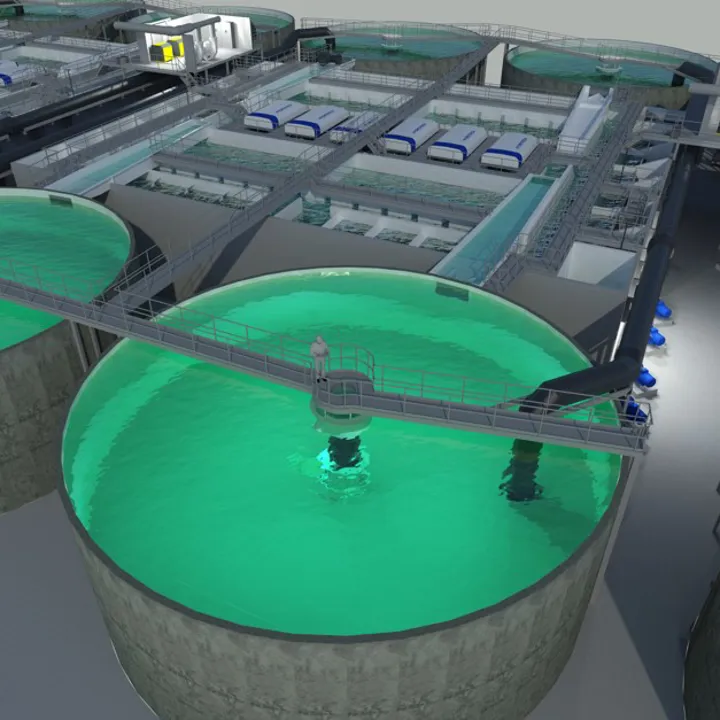
Modular RAS in Practice
“Standardized modular designs are a pathway to changing the story for RAS,” says KC Hosler Chief Technology Officer for PR Aqua, a RAS engineering and consulting firm based in Nanaimo, B.C. “There are so many advantages when it comes to modular systems.”
For starters, the process of project execution is much simpler when using a packaged design that is well-defined in advance of starting the build, Hosler notes. “There’s less to plan, there’s less to source, there’s less to negotiate. All of that planning process just gets simpler.”
Standardized modular RAS designs enable a shift from complex, customized designs to predictable systems, which allows operators to deploy proven and tested engineering designs rather than creating custom designs for every new build. Essentially, modular RAS is a series of “plug-and-play” designs that are pre-designed for optimal configuration, allowing a farm operator to choose from a “playlist” of RAS designs based on their production requirements.
“The overall theme of standardization is that instead of building every system like it’s a prototype or a custom system, you’re able to productize it and essentially improve it incrementally over a long period of time,” Hosler says.
While a relatively new concept, standardized modular RAS as a business and operational strategy has been gaining momentum around the world.
At its “gigafactory” in Finland, rainbow trout producer Finnforel, based in Varkaus, Finland, was able to scale its annual production to three million kilograms of rainbow trout, using a modular RAS design.
Through standardized production units, Finnforel can efficiently replicate and connect each unit allowing it to expand its production capacity “without compromising sustainability or quality,” according to a company post published in September 2025.
“Sustainability metrics remain stable regardless of scale because each module incorporates the same water purification systems, energy efficiency measures, and waste management protocols,” the company said in the post.

Higher simplicity, lower risks
Modularization addresses the performance uncertainty that has hindered many commercial RAS farms, especially in North America, according to Hosler. Because the design, execution and operation of these standardized modular systems have been proven, operational risks are significantly reduced.
With pre-defined operating procedures, the start-up process is streamlined, and the overall project schedule is shortened.
“On the operational side, standard operating procedures and training modules can be defined for the modules,” he notes.
Repeatability is a key aspect of modular RAS, which simplifies staff training and offers performance predictability across different units.
“Over time, incremental improvements to the design drive optimization, which drives all kinds of benefits both for the investor and the operator,” Hosler says, adding these improvements reduce system unpredictability.
Beyond system performance, the most important benefit to be gained from standardized modules is in the biological de-risking, by ensuring the stability of the production environment and protecting the health of the fish population.
“The biological de-risking with modularization is really important to me,” says Jamie Bridge, biologist and aquaculture specialist at PR Aqua with 25 years of experience growing fish.
“If you have a specific temperature requirement or if you have a specific water treatment requirement for certain species, it’s pretty easy just to plug in another system into it without having to create something from scratch.”
Economic impact
Standardized modular designs fundamentally alter the financial landscape of a RAS project. In custom-built mega-farms, construction delays and inflationary pressures can cause budgets to balloon by millions.
Modular systems, on the other hand, are pre-defined products rather than one-off prototypes, which means developers can move forward with cost certainty.
“We’re not building a prototype every time. We’re building a known product. The performance of that product is known, the cost of that product is known, and the time to execute that product is known,” Hosler explains.
This efficiency extends to the regulatory phase, as well. Permitting, which can be a notorious bottleneck for land-based aquaculture, becomes significantly more manageable when regulators are reviewing a “road-tested” design that has already met environmental and safety standards in previous installations, as demonstrated in recent high-profile cases.
Using a blueprint that is already documented and validated allows operators to shorten the lengthy permitting cycles typical of custom industrial builds, getting fish into the tanks and moving toward revenue much faster.

Sound investment
From an investment perspective, one of the primary hurdles for RAS’s investability centres on the massive capital outlay being tied to a relatively untested custom design at a large scale.
Standardized modules effectively de-risk the investment by providing a clear proof of concept at a more manageable scale. Instead of asking for hundreds of millions of dollars for a singular, unproven mega-structure, operators can secure funding for a single production module that can serve as a pilot project.
“You prove the biology, you prove the business model on a smaller scale, and then you just add more modules,” Bridge says.
Once that module demonstrates stable profitability and biological success, scaling the business is no longer a leap of faith; it is simply a matter of replicating the same proven unit. This “plug-and-play” scalability offers a level of predictability that traditional RAS projects lack, creating a more stable, mature investment profile that is more attractive to institutional capital.
Discuss Your Project
No matter how big or how small, or how far along your plans are, we can help. PR Aqua's technical knowledge and client commitment are second to none. Let's get started!