Modular Fish Incubation System

A containerized, recirculating fish egg incubation system for salmon, trout, and other salmonid hatchery applications.

Pr Aqua White Logo 21X9

What Is A Modular Fish Incubation System?

PR Aqua's Modular Fish Incubation System is a containerized, plug-and-play solution designed to provide reliable, high-performance egg incubation with precise temperature control in a compact, standardized platform. Delivered pre-assembled in a 20ft shipping container, the module enables rapid deployment and can operate as a standalone facility or as a building block within a larger hatchery development.

At A Glance

Species

Salmonids

Capacity

96,000 – 320,000 eggs

Water Reuse

90%

Deployment

Plug-and-Play

Standard Configurations

Three (3) Configurations Available

Applications

Enhancement, Commercial, Research

Eyed Eggs

Precise Water Temperature Control to Manage Egg Development

The modular fish incubation system allows hatchery operators to control rearing temperatures and water flows. Production schedules can be advanced or delayed to meet operational requirements, while thermal marking can be incorporated for stock identification and fisheries management. This provides greater production flexibility, improved planning, and enhanced support for hatchery and conservation programs.

Key Applications

The Modular Fish Incubation System is ideally suited for those seeking a standardized, scalable, and rapidly deployable hatchery solution. Typical applications include:

Commercial Production

  • Continuous aquaculture cycles demanding 99.9% uptime and industrial reliability.

Remote Installations

  • Self-contained units for off-grid or rural hatchery needs.

Research & Education

  • Modular setups for controlled variables in biological studies.

Pilot Projects

  • Rapid proof-of-concept installations with minimal onsite infrastructure.

Stock Enhancement Programs (SEP)

  • Precision-engineered environments optimized for conservation efforts and wild population replenishment strategies.

Benefits

  • Precision Management of rearing temperatures and flows
  • Production Timing Control by advancing or delaying egg development
  • Thermal Marking capability
  • Biosecure production environment
  • Plug-and-play containerized design
  • Recirculation for low water demand
  • Minimal Infrastructure requirements
  • Risk Mitigated design
  • Versatile Application range — see key applications
  • Modular scalable capacity
  • Factory built for faster deployment
  • Remote monitoring for operating safety

Standard Configurations

Three standardized configurations form the foundation of the Modular Fish Incubation System. These proven building blocks can be configured and customized to accommodate a wide range of production capacities, site conditions, and operational objectives.

Model INC-20CT-12 INC-20CT-14 INC-20CT-24

Fish Species

All salmonid species

Production *Note 1 below

96,000-192,000 eyed eggs

160,000–320,000 eyed eggs

160,000–320,000 eyed eggs

Incubators

Heath-style racks of 8 trays

Circulation Systems

1

1

2

Incubator Racks

2

4

4

Total Incubator Flow *Note 2 below

45 LPM (12 GPM)

91 LPM (24 GPM)

91 LPM (24 GPM)

Source Water Flow *Note 3 below

4.5 LPM (1.2 GPM)

9.1 LPM (2.4 GPM)

9.1 LPM (2.4 GPM)

Incubator Temperature

+4.0 °C to +8.0 °C

Running Power *Note 4 below

2.1-7.0 kW

2.4-7.3 kW

4.2-14.0 kW

Recirculation Rate

90% recirculated flow

UV Dosage

60 mJ/cm² at end of lamp life (based on UVT of 90%)

Notes:

  1. Production capacity is species dependent.
  2. Flow is based on 22.7 LPM (6 GPM) per 8-tray incubator rack.
  3. Source water flows are given as minimum values. Additional flow allows for greater operational flexibility, providing the ability to fine tune incubator rack temperatures within a temperature zone.
  4. Running power is dependent on the type and size of temperature control equipment selected.

Need something different?

These standard configurations serve as proven building blocks that can be modified and combined to develop customized solutions to suit your production goals, site constraints, and operational requirements.

Product Inquiry Form

Primary Components Container Key Component Labeling Visual

Primary Components

The following illustration identifies the principal process equipment incorporated into the standard system configuration. Installed in 20ft shipping container.

  1. Therapeutant Storage
  2. Temperature Stability Reservoir
  3. Incubator Rack
  4. Treatment Sump
  5. Washdown Sink & Worksurface
  6. Temperature Mixing & Dosing Apparatus
  7. Therapeutant Dosing Pumps
  8. Chillers
  9. UV Treatment
  10. Recirculation Pumps
Process Flow Diagram

Process Flow Diagram

The following process flow diagram illustrates how water and eggs/fish move through the Modular Fish Incubation System, highlighting the major processes and system components.

Frequently Asked Questions

Selecting an incubation system often raises questions about production capacity, water requirements, biosecurity, operational flexibility, and site infrastructure. The following answers address some of the most common technical questions we receive from hatchery managers, engineers, and project developers.

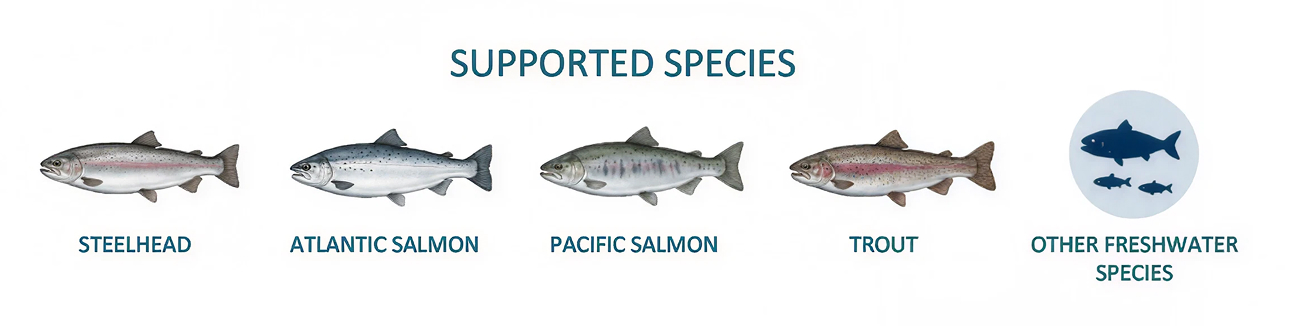
The Modular Fish Incubation System is primarily designed for salmonid species making it well suited for conservation hatcheries, stock enhancement programs, commercial aquaculture, and research facilities. The standardized platform is optimized for the biological and operational requirements of these species while providing reliable incubation and early rearing performance.

The system can also be adapted for other freshwater species through project-specific modifications to the incubation process and operating strategy.

Support Species

The Modular Fish Incubation System is available in standardized configurations capable of incubating approximately 96,000 to 320,000 eggs, depending on the selected configuration and fish species.

A modular fish incubation system delivers the same core incubation capabilities as a site-built hatchery while reducing project complexity, construction time, and deployment risk. Because the system is factory assembled, tested, and built around a standardized engineering platform, installation is simplified, quality is more consistent, and on-site construction is minimized. This approach provides a practical balance of performance, flexibility, and cost-effective deployment.

A recirculating aquaculture system (RAS) incubation system offers several advantages over a traditional flow-through incubation system, particularly through cost-effective and precise temperature control. By recirculating most of the flow, RAS systems significantly reduce influent water requirements, RAS systems can maintain stable incubation temperatures with less energy than would be required to heat or cool large volumes of flow-through water. This enables hatchery operators to accurately manage egg development rates, accelerating or slowing embryonic growth to achieve targeted hatch and release dates. The result is greater stability, predictability, and production planning confidence throughout the incubation process. Temperature control also supports thermal marking programs, allowing enhancement hatcheries to create distinct otolith thermal marks for stock identification and fisheries management purposes. In addition, RAS incubation systems improve biosecurity by limiting exposure to external pathogens and contaminants and provide a highly controlled environment that supports consistent egg performance and hatch success.

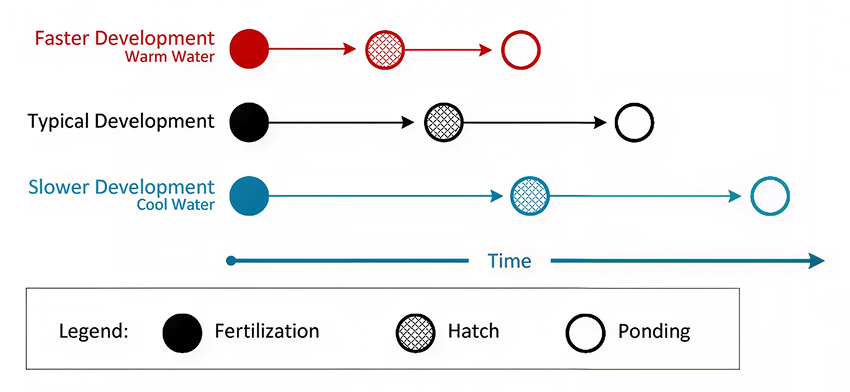
The Modular Fish Incubation System allows operators to precisely control water temperature, enabling egg development to be accelerated or delayed to meet production schedules. By maintaining independent temperature zones, hatcheries can better coordinate ponding schedules, synchronize production with seasonal stocking windows, and optimize the use of available hatchery space. Optional ATU (Accumulated Thermal Unit) tracking by incubation rack further supports production planning by forecasting expected ponding dates and tracking egg development.

Temperature Control Chart

The Modular Fish Incubation System requires a continuous supply of clean surface water or groundwater at a flow rate of 4.5-9.1 LPM (configuration dependant) and at a temperature of 1-12°C. By recirculating up to 90% of the process flow rate, the system minimizes freshwater demand while maintaining excellent water quality. Pre-treatment may be required depending on the source water quality.

A modular fish incubation system typically requires a level site, a reliable source of clean surface water or groundwater, electrical power, and a suitable discharge location. Designed for rapid deployment, the factory-built module minimizes on-site construction and supporting infrastructure requirements. Optional internet, cellular, or satellite connectivity can be provided to support remote monitoring and alarm notification. PR Aqua confirms site suitability during the design phase to ensure the available infrastructure supports reliable system operation.

Site Requirements

Land Space

A level flat site; minimum 9m L x 2.7m W (30ft L X 9ft W

Source Water

Surface water or ground water source at 1-12 °C

Power Supply

240 V / 1PH / 60Hz; backup power source required

Road Accessibility

A gravel access road or better, suited for heavy transport access

Water Pressure

5 psi minimum

Discharge

Discharge into an Infiltration Basin, French drain, or direct to water body

Comms Connectivity

Internet, cellular, or telephone connectivity (optional SAT)

Because the Modular Fish Incubation System is factory assembled and tested prior to shipment, on-site construction is significantly reduced compared with a conventional solutions, simplifying installation, shortening project schedules, and reducing project risk.

The Modular Fish Incubation System uses redundant critical equipment and automated alarm monitoring to help maintain essential water circulation, temperature control, and treatment functions during an equipment failure. If a primary component stops operating, the standby equipment can maintain system operation while personnel are notified through the alarm system. This redundancy reduces the risk of abrupt changes in incubation conditions and provides operators time to respond before egg health is affected.

Yes. The Modular Fish Incubation System is built around a series of standardized configurations that meet the needs of most hatchery applications while allowing project-specific customization. Standard modules can be expanded, reconfigured, or adapted to accommodate different production capacities, site constraints, operational objectives, and fish species. This approach combines the reliability and efficiency of a standardized engineering platform with the flexibility of a custom solution, without the cost and risk of an entirely custom design.

Product Inquiry

PR Aqua is the manufacturer of the Modular Fish Incubation System. To help us begin evaluating your incubation needs, please answer the following questions. Someone will contact you shortly to gather additional information.

Product Inquiry Form